
What Oscoda County Deed Records Show
Each recorded deed filed with the Oscoda County Clerk/Register of Deeds names the transfer parties, carries a recording reference, and ties the instrument to a legal description. That description is what the index really turns on. The legal effect still depends on the instrument itself and the title history behind it. Presence in the index never guarantees clear ownership.
| Deed Type | What It Does | Common Use |
|---|---|---|
| Warranty deed | Conveys the stated interest with deed covenants | Conventional transfers |
| Quitclaim deed | Conveys whatever interest the grantor holds | Family or corrective transfers |
| Fiduciary deed | Records a transfer made by an authorized representative | Estate or trust administration |
| Sheriff or foreclosure deed | Memorializes a transfer arising from a legal process | Foreclosure research |
| Tax-related deed | Records a conveyance after the statutory tax process | Delinquent-tax history |
The instruments serve different purposes. A deed transfers an interest, while a mortgage only secures a debt. An assignment shifts who holds that security. A discharge or release proves a claim was paid off. Liens can burden land without moving title at all. A usable chain needs every instrument family searched, not just a single owner name.
The Oscoda County Register of Deeds Counter
The Clerk/Register of Deeds sits at 311 S. Morenci Ave. in Mio, with mail going to PO Box 399, Mio, MI 48647. The office lists 989-826-1110 and countyclerk@oscodacountymi.com. Hours run weekdays 8:30 a.m. to 4:30 p.m., closed noon to 1:00. No appointment is needed. Public terminals are available at the counter. Searchers do their own name and document work. Staff will not run title or document searches. Paper copies carry a fee, though the current amount is not posted; call ahead before mailing anything. Give the names, the approximate recording date, the instrument type, and any book/page or document number. Say plainly whether you want a certified copy or a regular one.
Oscoda's 1985 Electronic Deed Cutover
County real-estate holdings date to the late 1800s. But the electronic land records start in 1985. Anything earlier lives on office microfiche. New submissions get time-and-date stamped and checked against recording requirements. Each is assigned a document number, indexed, and scanned. The online collection stays current within five days of recording.
The cutover changes the method, not the trail itself. When a chain hits 1984, leave the web index for the microfiche. The deed-book references wait there too. Note each grantor, grantee, date, legal description, and citation before stepping back. A family story or street address rarely bridges that electronic boundary alone.
Note: Verify a recent closing in the deed index even if the assessment roll shows the prior owner of record.
Three Fidlar Routes to Oscoda Deeds
DirectSearch is the free public route into the deed records. Tapestry works on pay-as-you-go or account access. Laredo is a subscription product. Its application is supplied by the county. The county credits Laredo with multiple search fields and saved searches. It also supports printing of results or images. Start with party names and a date range. Then narrow the set with whatever document type or recording reference the portal displays. If a portal stalls or an image will not load, fall back to the public terminals. You can also request a paper copy from the office. The county's recorder page lists the electronic cutoff and spells out the access choices.
When a vendor screen will not cooperate, the county's own recorder page is the safest place to confirm contacts and routing before a deed search.
Read Oscoda's Grantor-Grantee Index
A chain always starts from a known owner and works backward through named transfers. The Oscoda County property search supplies that current owner lead. From there the deed index carries the recorded conveyances.
- Find the current owner's acquisition instrument with that owner as grantee.
- Read the grantor, date, deed type, legal description, and recording reference.
- Search that grantor as an earlier grantee and match the same land description.
- Repeat transfer by transfer; move to microfiche when the chain passes 1985.
- Grantor
- The party conveying the stated interest.
- Grantee
- The party receiving that interest.
- Chain of title
- The linked sequence of recorded conveyances affecting the same land.
- Book/page or document number
- The recorder's retrieval reference; use whichever appears on the index entry.
Match the Legal Description, Not Just a Name
Names alone breed false matches. One person may hold several parcels. An LLC may share a near-identical name. A trust or estate may appear only through a fiduciary. Compare the legal description every single time. A lot-and-block description points to a recorded subdivision plat. Metes-and-bounds language runs on courses, distances, monuments, sections, and adjoining land. The parcel number is an administrative cross-reference, not the land itself. Its 11-digit Oscoda format keeps notes aligned with assessment and tax records. The county publishes no segment key, so never guess what each digit means. The deed or recorded plat controls the description. For a split tract, weigh both the parent description and the later parcel-combination or land-division record.
Estate Transfers Can Break a Simple Deed Chain
A missing conventional sale often means probate. It can also point to a trust administration, an affidavit, or another fiduciary instrument. Search the deceased owner's name in the recorder index first. If the path stays murky, the local probate file shows authority and distribution. A death certificate helps with identity and timing, but it conveys nothing.
Heirs put this to practical use all the time. They line up the recorded instrument and probate orders. With Oscoda County deed records, heirs can then add tax-year evidence around inherited land. Michigan restricts birth records until more than 100 years old. Death and marriage copy rules differ. Use the County Clerk or state vital-record channel sparingly. Request only the supporting record you actually need.
Monitor New Oscoda County Filings
Oscoda County offers a free watch service through Property Fraud Alert. Sign up a name you care about. When that name shows up in a recorded filing, the service sends notice by phone or email, and telephone enrollment is available at 1-800-728-3858. Think of it as a tripwire, not title insurance. An alert never decides whether an instrument is valid.
The county-specific enrollment page shows the signup route.
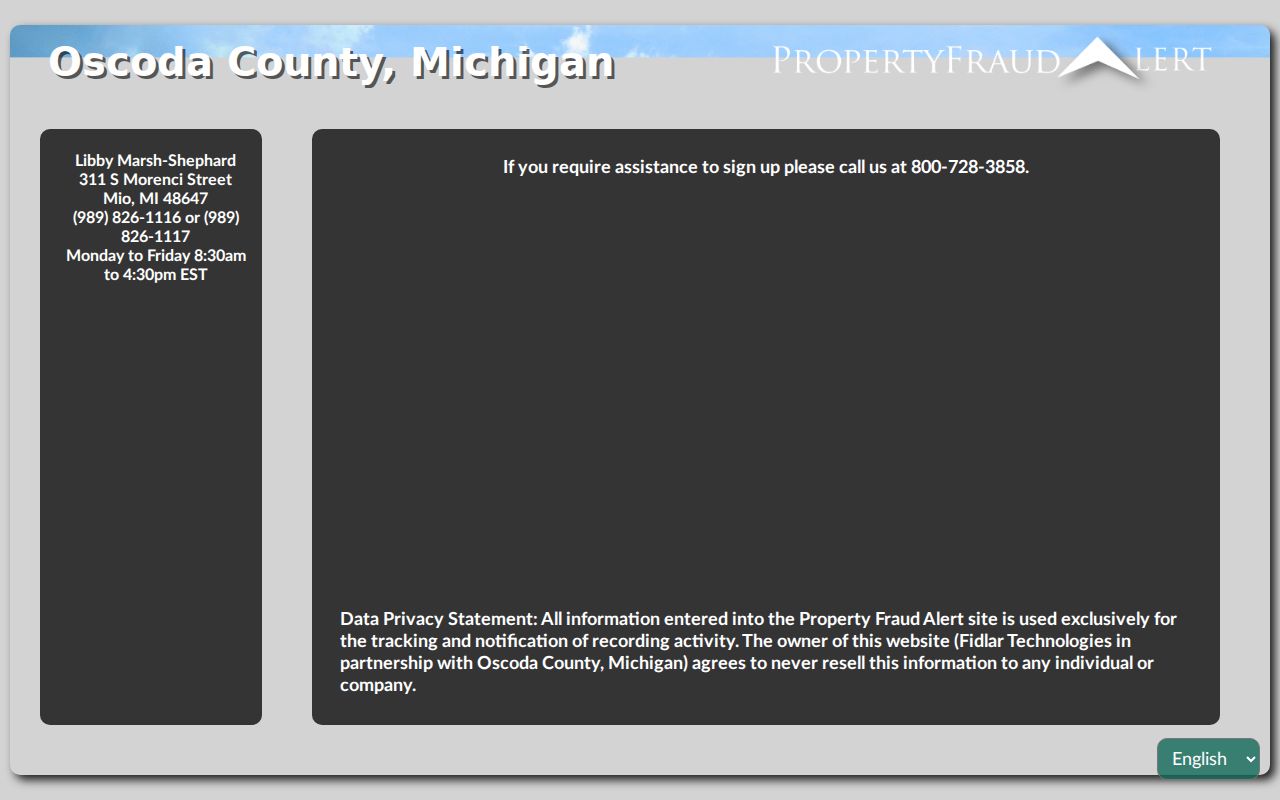
An unexpected alert is a prompt, not a verdict. Pull the actual recorded document and contact the Register of Deeds rather than treating the alert summary as the deed itself.
Historic Deed Leads Beyond the Courthouse Screen
Older deed research in Oscoda County can start away from the courthouse screen. The Library of Michigan's Oscoda County guide catalogs a 1930s Hixson plat, a 1942 map, a 1962 owner-index plat, and later atlas material. A plat like these can name an earlier owner, township, section, road, or subdivision. That detail helps before you turn to microfiche. Wording matters too. Historical sources sometimes spell the county seat as “Mioe.” Fairview's post-office location shifted over time. Alternate place names can unlock a stalled chain of deeds.
Courthouse history also shapes a search. The 1888 building burned in 2016, temporary offices followed, and the replacement opened in 2020. Confirm where a given record group now sits. The fire is no proof that deed books were lost. The recorder states plainly that land records reach the late 1800s. Microfiche handles pre-1985 searching.
Obtain an Oscoda County Deed Copy
Pull the reference online first. From there, inspect or print the deed through the applicable Fidlar tier, or use the counter terminals. Mail requests go to the Clerk/Register of Deeds at PO Box 399, Mio, MI 48647, with enough identifying information to locate the deed record. Send UPS or FedEx deliveries to 311 S. Morenci Ave. Include a self-addressed stamped envelope; the office appreciates it. The county sells paper copies for a fee and will not accept a photograph in place of a copy. Check the current plain-copy, certification, and image charges before you send payment.
Recording submissions have their own routes. Documents may be hand-delivered without an appointment, mailed, sent by carrier, or filed through listed e-recording vendors. Certified court documents and death certificates may not qualify for electronic submission. Call the office first. Also note that the recorder supplies neither blank legal forms nor legal advice.
Recorded, not guaranteed. Oscoda County deed records show instruments accepted for recording, not a legal conclusion about clear title. Unrecorded interests and defects may exist; consult a qualified attorney or title professional when that conclusion matters.