
Three Meanings of Oscoda County Property Value
Two county records carry the valuation story. The Equalization file holds assessment figures, while the recorded deed preserves what a transfer stated. Michigan calls the market concept true cash value, uses state equalized value for the equalized assessment, and reserves taxable value for the tax base.
| Value | What It Is | Where |
|---|---|---|
| Assessed value | Local assessor's mass-appraisal figure, generally targeted at 50% of true cash value | Assessment roll and parcel card |
| True cash or market value | Estimated usual selling price under Michigan law | Implied by assessment level; not a sale appraisal |
| Taxable value | Value used as the base for property tax calculations, subject to caps and uncapping | Assessment roll |
| Last sale consideration | Amount tied to a recorded transfer when disclosed | Deed or transfer record |
These labels are not interchangeable. A sale can close after the assessment date, and taxable value can sit below assessed value. A recorded price may also reflect circumstances that look nothing like an open-market transaction.
Michigan's 50% Level Shapes Oscoda County Values
The Oscoda County Equalization FAQ covers assessed value, taxable value, state equalized value, capped value, transfers, the principal residence exemption, and appeals. Michigan targets assessments at 50% of true cash value. Doubling an assessed figure suggests the assessor's implied true-cash context. That shortcut is not a market appraisal.
County Equalization reviews local assessment levels across the six townships. State equalization then keeps treatment uniform. Read every value with its tax year. Pair it with the parcel number, since one address can produce figures from different cycles.
Note: The 50% assessment level is a mass-appraisal framework, not a formula that predicts a property's next sale price.
Taxable and Capped Values Follow a Different Track
Taxable value is not another name for assessed value. Michigan's cap limits annual growth. A transfer of ownership can uncap it in the next assessment cycle. The state transfer-of-ownership guidance explains when a transfer changes that path. A sale does not reset the next assessment to half the purchase price, either. Assessors rely on the statutory mass-appraisal process. Taxable value follows its own cap and transfer rules. That is why two similar homes nearby can carry different taxable values. Their assessed figures may sit close.
- Assessed value
- The assessor's value at Michigan's assessment level.
- True cash value
- The state's market-value concept.
- Capped value
- The statutory limit used in calculating the next taxable value.
- Reassessment
- The annual process of placing a value on the roll.
Read the Oscoda County BS&A Value Fields
The BS&A Online county hub supports searches by address, owner name, and parcel number. A typical parcel card pulls the numbers together. The official sample for 412 N. Morenci Avenue displays a parcel number, an entity owner, and property details. It also shows assessed and taxable value, plus tax information. Transcribe any value with its year and label. Never call taxable value "market value." Do not infer a missing sale amount from the assessment either.
The hub also separates assessing, tax, property, and sale-oriented choices. One screen rarely holds every number. See how a real parcel card groups these figures. View the official BS&A sample source.
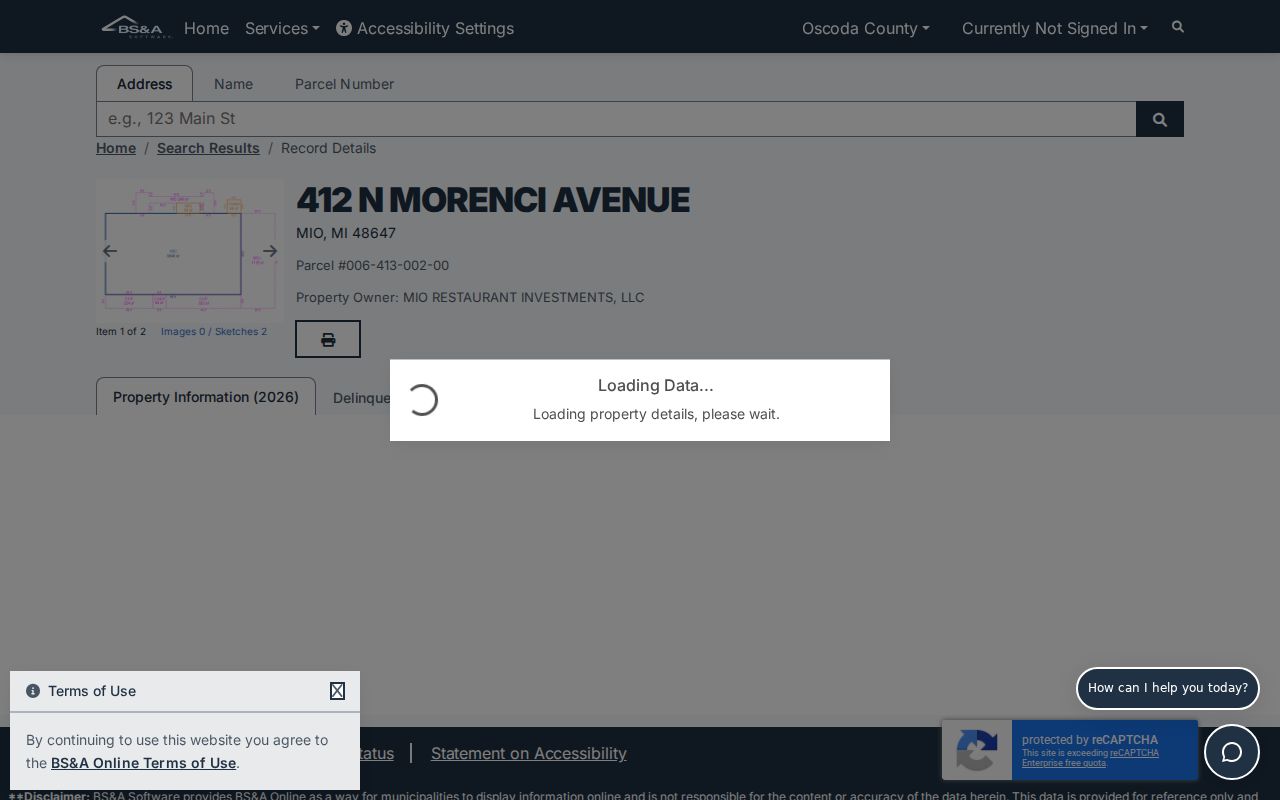
A saved result works as a field guide. The live parcel record and the current year remain the authoritative lookup.
Look Up an Oscoda County Property Value
Focus the search on the parcel. Identify it, then read the right value-year pair. Confirm the deed only when a sale figure or transfer date is part of the question.
- Search the situs address in BS&A and verify the complete APN.
- Record assessed value, taxable value, and the year attached to each.
- Use the latest recorded deed when sale consideration matters.
- Compare dates and value types before making any estimate.
- Sale consideration
- The amount stated or reflected in a transfer record, when available.
- Assessment level
- The relationship between assessed and true cash value.
- Value year
- The year to which the displayed figure applies.
Recorded Sales Add a Separate Oscoda County Number
The Clerk/Register of Deeds keeps the transfer instrument. Oscoda County's electronic land records start in 1985. Older records sit on office microfiche. Online documents may be current within five days of recording, with access through Fidlar DirectSearch, Tapestry, and Laredo. A deed's consideration adds market evidence. Not every transfer is an arm's-length sale, though, and family, estate, trust, nominal-consideration, and partial-interest transfers can make the recorded amount a poor benchmark. Check the transfer date and deed type before comparing it with an assessment.
Annual Reports Put Oscoda County Values in Context
Equalization publishes annual reports from 2013 through 2026. Those reports give county and class context. They can show whether a change reflects a wider assessment pattern rather than a fact unique to one property. A single parcel card cannot supply that view.
The Archives of Michigan also identifies Oscoda County assessment-roll runs from 1885 through 1935, plus later series beginning in 1940 or 1960. Historic rolls support property-history research. Their amounts should not be converted into current market estimates without a sound method. Treat them as history, not comps.
PRE Status Changes Tax, Not Market Worth
The principal residence exemption affects school operating taxes. Michigan describes it as an exemption from up to 18 mills. Poverty and other exemptions likewise concern tax treatment and eligibility. An exemption flag does not shrink the land. It does not establish a lower open-market price either. Keep exemption and tax-bill analysis on the Oscoda County property tax records page, and for valuation note only that taxable consequences can differ between parcels with similar assessed values.
Note: An exemption explains tax treatment; it should not be reported as a discount to a property's market value.
What Oscoda County Property Value Records Cannot Prove
An assessment cannot fix an exact selling price. It proves no replacement cost, clear title, surveyed boundary, or building condition, and it exists for the property-tax system, where it can trail rapid market changes.
Value vs price. An Oscoda County assessed value is not what the parcel will necessarily sell for. Obtain a licensed appraisal for a current, property-specific opinion.
Use a current inspection and appraisal for condition-sensitive decisions. Deeds supply transfer facts, the assessment roll supplies official value labels, and the two complement each other without becoming interchangeable.